Saturday, January 30, 2016
TPT "Learning is Love" Crave - Win a $25 Gift Card
Learning is Love. Teaching is Heart. If you're like me, you love to teach, but sometimes the budget we need to instill a love of learning in our students is tight. Three Texas Teachers have joined together to help lighten the budget burden with a chance to win a TPT Gift Card!
Click Here for Your Chance to Win!

Monday, January 25, 2016
A Tale of Two Homeworks
 "It was the best of times; it was the worst of times." That classic line from Charles Dickens' A Tale of Two Cities pretty much sums up my feelings about homework. I believe that students need to complete work outside of the classroom to prepare for the rigors of college and professional work life, but there are times when the homework return rate is abysmal. I've often asked myself: "What's the point of assigning homework when only a small percentage of students turn it in?" I've personally witnessed kids copying a classmate's work right before class or scribbling as hard as they can to get a little credit. I've been given every excuse (from kids and parents) and have tried almost trick in my toolbox. Some teachers at my school have given up on homework for this very reason. It's definitely the "worst of times."
I've taken some time to review my homework success rates. There are several approaches I take that has led to more success.
Get 'Em Moving at Home
We have all used them...that worksheet with column after column of problems. I can totally understand how this type of homework can lead to extreme boredom at home. I think kids benefit when they can use concepts we learn during class to explore the real world of math. For example, for part of our geometry unit, students learn about the volume of rectangular prisms. I do have a traditional homework sheet available, but I also give students the opportunity to explore volume at home by measuring a household object and finding the volume. Guess which one the students prefer?
 |
| Traditional Homework |
 |
| Get 'Em Moving Homework |
Flip the Script
Flipping the classroom has definitely helped students complete work outside of the classroom. I started posting videos on my online classroom (I use Quia, but your district may have Schoology, Edmodo, or Moodle). Instead of doing math problems at home, students work on note-taking skills. I have two particular formats we use for notes. We then focus on math problems during class. Some days, I give students who don't watch the videos at home the opportunity to complete them during class while other students are working in groups.
Nothing New, Home for Review
In the past, the homework I assigned focused on the topic we covered in class that day. I realized that one of the reasons students didn't complete the work is because they were stuck on a problem and gave up or decided to wait and ask me how to approach the problem during the next class period. To address this issue, I started assigning spiral review homework. It focuses on topics we've already covered with varying degrees of difficulty. I saw homework completion rates increase with this approach.
Ten or Less is Best
I've taken some heat for this approach. Generally, I assign ten or fewer problems for homework. There are times it increases to 15 or so, but not very often. I've found that if students "get it," ten problems helps them get the review or reinforcement they need to be successful in my math classes. If they get ten problems wrong, they're going to get 20 problems wrong. There is no need to have them complete problem after problem if I need to work with them to make sure they understand a particular math concept.
Paperless Homework
Google forms and Quia have definitely helped me save a ton of paper! I post the problems online and students submit it. Simple, yet effective. It has the added benefit of allowing me to see when students are completing their homework. What I love most about paperless homework is that it allows me to give students the opportunity to fix problems before they submit it for a final grade. I often ask them, "Why not go for 100% mastery?"
Variety is the Spice of Life
Instead of assigning one type of homework all the time, I use all of these approaches to "keep it fresh." I'm also researching more ways to get students to enhance their learning outside of the classroom. Do you have an innovative way to get kids to complete homework? I'd love to read about your tips and tricks.
My challenge to you this week: try a different approach to homework and see if it makes a difference.
Monday, January 11, 2016
What's the Connection between Fashion and Math?
 I love asking my students questions such as the one in the title. The answer can be found on a wonderful website called Get the Math. Don't just get the math - grab it! Once you start using the materials from this wonderful website, you will understand why it is one of my favorites. Oh, maybe you're wondering where the link is to the awesome goodness that is Get the Math...
Get the Math offers excellent representations of using math in the real world. As a true fan of Project Runway, the lesson with Chloe Dao - who won season two - is one of my go to lessons from this website. Her lesson focuses on how fashion designers use math to design clothing for different sizes. It starts with an introductory video about Dao and ends with a challenge. Students have to calculate the costs of manufacturing a design that will have a 220% markup. To plan for this lesson, I picked up a few inexpensive t-shirts from a discount retailer. I rearranged the desks so students could work in groups to complete the challenge. The kids had a lot of fun and learned at the same time.
To extend the lesson, students could design their own simple t-shirts and set a price for them. They would have to research the cost of the t-shirt as well the cost for printing images or adding embellishments. Their mark-up would have to be a certain percentage. In my classes, they would meet in small groups with their finished products. Each group would present one t-shirt to display and explain why they chose it.
I love Get the Math because it offers real-world math connections along with inspiration for project-based learning. This is a win-win in my view. The diversity of the lessons gives teachers the opportunity to reach the interest levels of all students. Hopefully, you'll find it useful as well.
Wednesday, January 6, 2016
Classroom Hack: Student-made Rational Number Cubes
 If you're like me, you love using number cubes and dice in the classroom. They are versatile tools perfect for a variety of math games and enrichment. There are times when I find the number cubes limiting because the cubes that include fractions and decimals are basic. They include unit fractions and decimals to the tenths place. I've been searching everywhere for cubes with different types of rational numbers. My search ended with a trip to my favorite dollar store!
There, I found packages of blank foam counting blocks. Each package contains 50 blocks. The price - $1.00. I grabbed a couple of packages for my classes and rejoiced in the knowledge that I would soon have the best number cubes ever!

First, I separated the number cubes and placed sets of them in small cups. The cubes come in colors of red, blue, green, and orange.

Although students normally carry Sharpies, I also placed them on the desks for each group. I gave the students simple instructions:
(1) Make a list of 6 rational numbers in your spirals. The rational numbers must include at least two negative numbers, 1 integer, 1 decimal, 1 fraction, and 1 percent.
(2) Review your numbers with your group members to make sure none of you have the same rational numbers. Make modifications if necessary.
(3) Select one number cube and one Sharpie (fine point). Write your numbers on the six sides of the number cube.

Within two days, I had 150 number cubes with a wide variety of rational numbers. Not only did my students practice the important skill of generating rational numbers, but there was also 100% engagement! So, how do we use the number cubes?
- Comparing rational numbers: roll two cubes and compare
- Ordering rational numbers: roll four cubes and order the numbers from least to greatest or greatest to least
- Rational number operations
- Graphing rational numbers on number lines
Saturday, December 26, 2015
Teachers, Your Giftwrap May be Hiding a Secret...
 It's the Sunday after Christmas, and if you're like me, you're already searching for some great clearance deals. I'm on the hunt for wrapping paper, and some of the stores I visited are offering 50-75% off this holiday staple. Wrapping paper - also called giftwrap - is great for working on activities involving volume and surface area. So, I stock up when I can. Dollar stores always have deals on giftwrap. There's another reason I like giftwrap - it is "hidden" on the side without all the bright colors and playful prints. If you have a roll of giftwrap, you may have a cost-cutting treasure on the opposite side.
Normally, a roll of coordinate grid paper costs $30 or more. For $1.00, budget-minded teachers can use the back side of giftwrap for the grids. Not all giftwrap has grids, but all of the paper I've purchased from Dollar Tree has had them. If offers an excellent alternative to basic black and white grid paper - at a fraction of the cost!
 |
| Yellow Grids Lines on Giftwrap |
Kids Love Color
Even though kids will use the back side of the paper, they are excited to use educational materials that are unique and colorful. You'll never go wrong with samples of giftwrap. If you choose giftwrap with grids, you may notice that some grid lines are darker than others, but they are noticeable.
Learning about the Cartesian Coordinate system
Cut out squares of giftwrap and distribute to students. Review the Cartesian Coordinate system with students and allow them to "take notes" on the paper. Once their notes are finished, they can fold up the sides to complete the activity.
 |
| Cartesian on Giftwrap |
Mystery Pictures and Scale Drawings
My favorite activities to use with wrapping paper grids are mystery pictures and scale drawings. Students work in pairs. One student receives standard grid paper and his or her partner receives a section of giftwrap. Students complete the mystery pictures and compare the pictures to find the scale. Students can also work individually to scale pictures.
 |
| One big, one small, and a great lesson! |
Saturday, December 12, 2015
Favs for the Holidays
The holiday break is almost here, and Angela from Southern Fried Teachin' is asking educators about their favorite things. I love hooting about favs, so I thought I'd join in on the fun!


1. Favorite Holiday Song: Christmas Canon from Trans-Siberian Orchestra. It always gets me in the spirit.
2. Favorite Holiday Guilty pleasure food: my mother's creamy pork chops!
3. Favorite Holiday Tradition: Getting together with Family
4. Favorite Holiday Book: A Christmas Carol
5. Favorite Holiday Act of Kindness: Giving presents to those who need assistance.
6. Favorite Holiday Memory: There's too many; I can't choose just one!
7. Favorite Holiday Childhood Gift: That's easy; my first computer.
8. Favorite Holiday Craft: Gingerbread houses
9. Favorite Holiday Movie: Home Alone
10. Favorite Place to Shop for Holiday Gifts: Amazon. I'm wearing out my Prime membership!
11. What I want Santa to bring me: A new computer and a 3D printer.
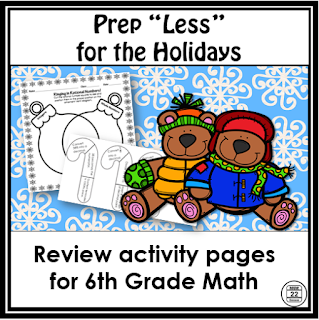
12. Favorite Holiday Product: Prep-Less for the Holidays with Holiday Math for 6th Grade!
Wednesday, December 9, 2015
Classroom Hack: Tic Tac Penguin

I love, love, love dollar stores. I've found my best classroom hacks in dollar stores, and now that I'm preparing for the holidays, it's good to know I can rely on them for excellent ideas for activities.
Just $1 (plus tax) was enough to pick up this tic-tac-toe game with a penguin. My goal: to make a review activity for students.

First, I inserted labels in the spaces. Using labels allows anyone to change the format of the game at anytime. Whenever it's time to make a change, just remove the old labels and insert new labels!

Next, I selected a set of 9 task cards on topics students need to review. Task cards with QR Codes work well because they allow students to self-check their answers while working. I used triangle inequality task cards for this game, but any task cards will work. Instead of two students playing tic-tac-doe with another student as scorekeeper, only two students are needed when using QR codes. That means more engagement. Win, Win for everyone! I also downloaded a free snowman spinner from Creative Clips and added numbers. The game was ready for a math center!

Playing "Tic-Tac-Penguin" is as simple as the traditional game! Students use the spinner to determine which card to use. If the calculate the correct answer, they can place an "x" or an "o" on the corresponding number on the tic-tac-toe board. A student will lose a turn if he or she spins a number of a card that has already been solved.
Kids will LOVE this alternative to traditional review as we all prepare for the holiday break. It all started with $1!!!
Subscribe to:
Posts (Atom)